Conflict Resolution Isn’t Something We Just “Pick Up”
There's a version of childhood many of us remember where conflict resolution just... happened. Two kids argued over whose turn it was on the swing, sorted it out (badly, at first, then better), and moved on. No adult scripted it. It was simply what free play required.
That version of childhood is a lot less common now, and it's changing what we need to do in our classrooms — and honestly, in our own lives too.
Why play builds this skill better than almost anything else
Free play puts us in exactly the situations that require negotiation: limited resources, competing goals, and no script telling us what to do next. Navigating that scenario repeatedly is how we practice decision-making, sharing, resolving disagreements, and advocating for ourselves — all at our own pace (Ginsburg, 2007).
This isn't a side effect of play. It's core to what play is for. The same play that builds vocabulary, attention, and creativity also strengthens social skills, emotional intelligence, and conflict-resolution ability more broadly (Jensen, 2005).
The shift: from "we'll figure it out" to "let's practice it"
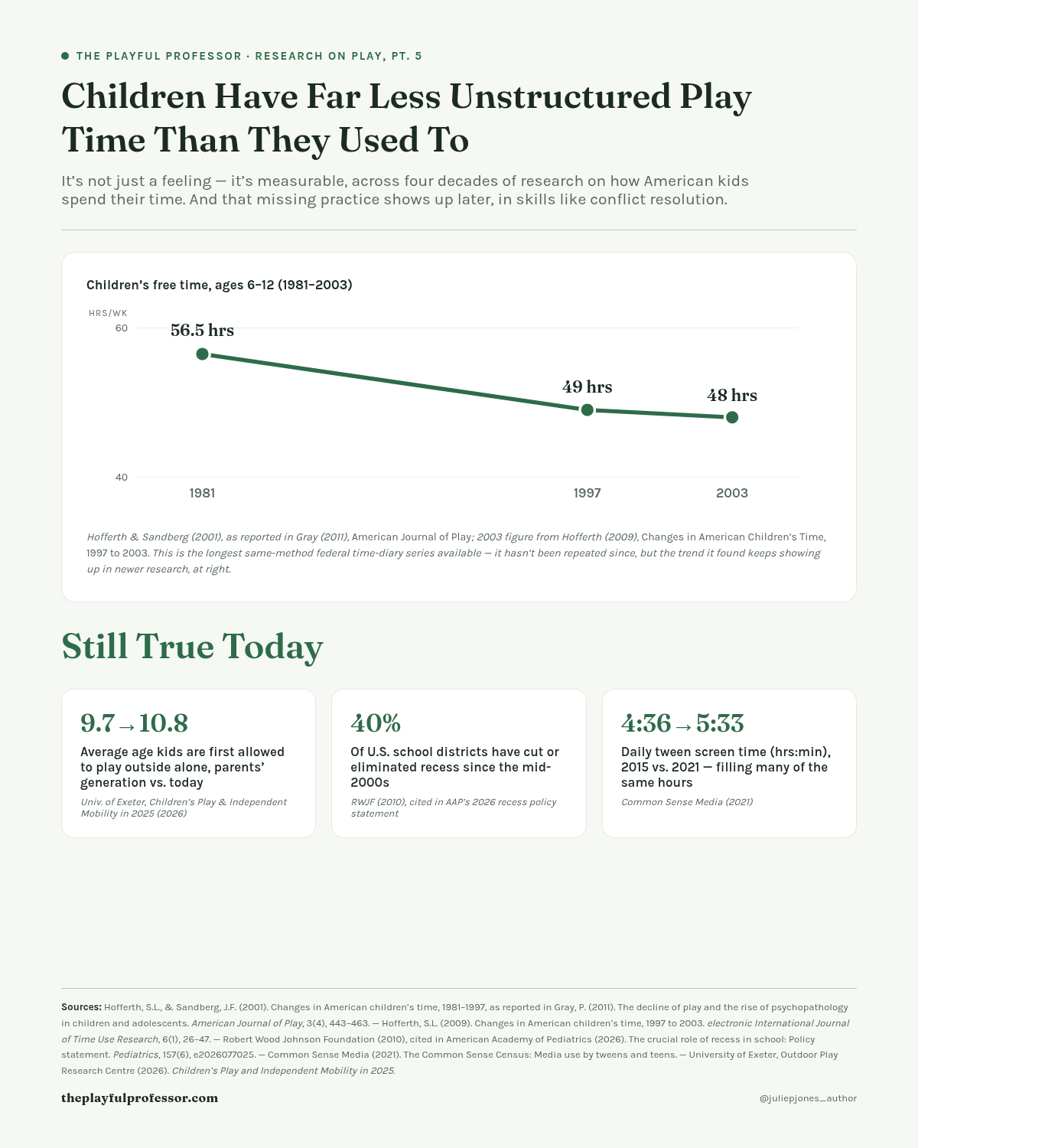
With less unstructured play time than previous generations had, many of us simply haven't logged the hours of practice that used to come free with childhood. That's not a deficit in any one of us — it's a gap in the practice we've had access to.
A simple script to practice, out loud, in real time
1. Pause. Take a breath before reacting.
2. Name the problem clearly — no blame, just what's actually happening.
3. Listen to each other, then look for common ground.
4. Agree on a solution and act on it — then circle back and ask: did that work for both of us?
For younger learners, sentence stems help: ** "I feel \_\_\_ when \_\_\_ because ___. ___What I need is ."
The bigger picture
Play is where we rehearse being human with each other — reading tone, managing disappointment, finding compromise, trying again if it goes poorly the first time.
Sources
Ginsburg, K. R. (2007). The importance of play in promoting healthy child development and maintaining strong parent-child bonds. Pediatrics, 119(1), 182-191. https://publications.aap.org/pediatrics/article/119/1/182/70699/The-Importance-of-Play-in-Promoting-Healthy-Child
Jensen, E. (2005). Teaching with the brain in mind. Alexandria, VA: ASCD.
Do you need additional support for incorporating play in your life?
Follow my quest for the playful life: Instagram, Facebook, LinkedIn
Consider buying my books on Bookshop.org, Barnes & Noble, Target, or Amazon. I appreciate the love.
Read the free content on my website.
Buy some PLAY-swag.