The Opposite of Play Isn’t Work. It’s Depression.
According to the National Institute of Mental Health, an estimated 21 million adults in the United States — about 8.3% of us — experience at least one major depressive episode annually. Play researcher Brain Sutton Smith spent decades studying what depression and play have in common — or rather, what they don’t. His conclusion has stuck with me: “The opposite of play is not work. The opposite of play is depression.”
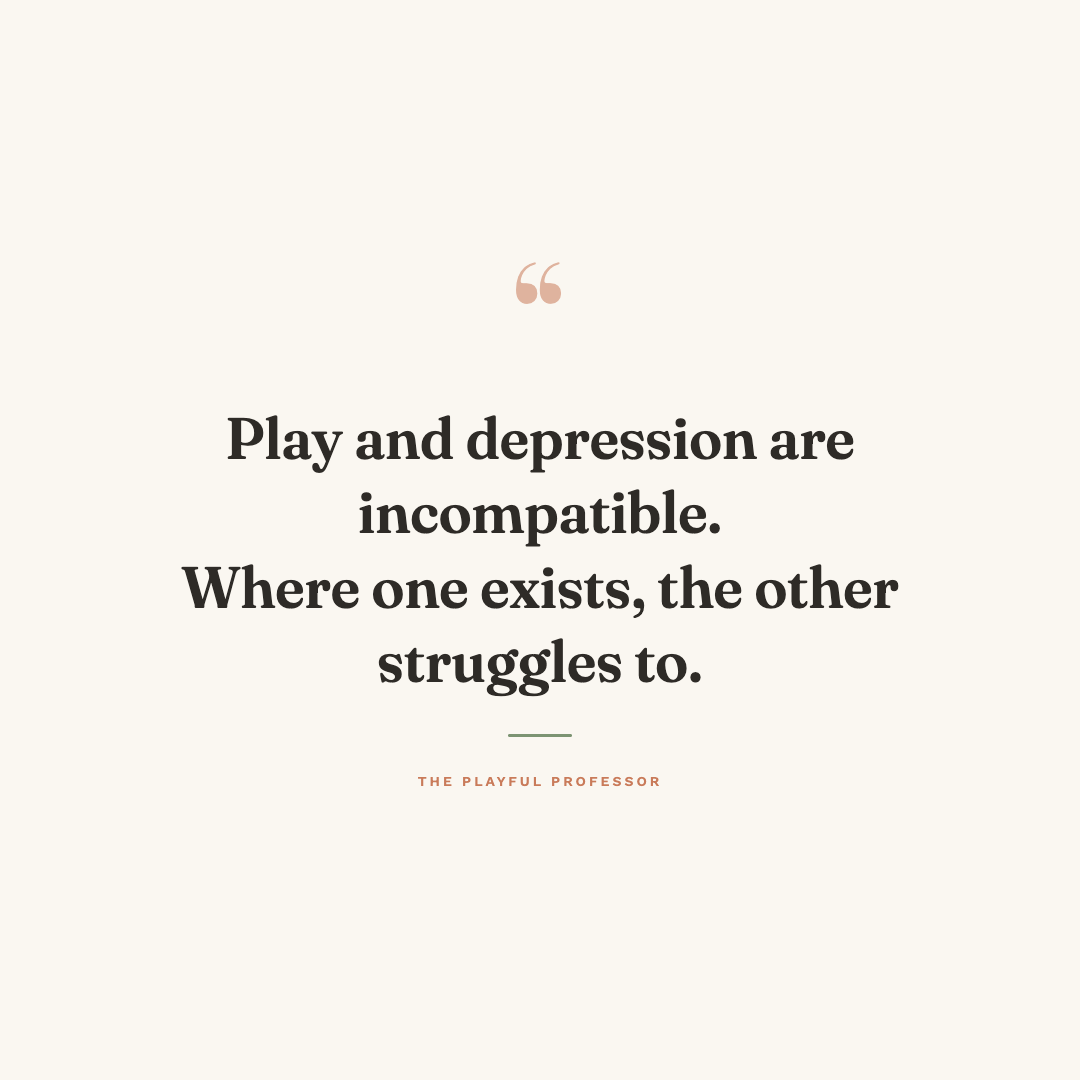
Play and depression are incompatible.
Where one exists, the other struggles to.
That idea reframes an old assumption. We’ve been taught that play is optional — a reward earned after the “real” work of managing our mental health is done. The research — from Brian Sutton Smith to Stuart Brown — suggests something closer to the reverse: play may be part of how we do that work.
What trauma steals, play helps return
Psychiatrist and trauma researcher Bessel van der Kolk describes trauma as, at its core, a theft of our sense of being in charge of ourselves — our minds, our bodies, our reactions. Healing, then, isn’t only about processing what happened. It’s about reclaiming that ownership, one small, embodied experience at a time.
This is where play re-enters the picture — not as distraction from the work, but as a legitimate path through it.
Playful paths to healing look different for different people
Not everyone regulates the same way, and that’s the point — there isn’t one correct form of self-care. A few playful, evidence-backed entry points, drawn from van der Kolk’s research and beyond:
Touch and movement. Mindful touch — even something as simple as a massage — is one of the most natural ways the body calms itself and discovers tension it didn’t know it was carrying (van der Kolk, 2014).
Meditation. Regular meditation practice is associated with measurable changes in brain regions tied to attention and stress regulation (Lazar et al., 2000).
Storytelling and writing. Telling our own story, in our own words — a journal, a letter never sent, a voice memo — changes how we relate to what happened. Our sense of self shifts as we narrate it (van der Kolk, 2014).
Art and music. Creative expression gives feelings and images context. It’s hard to imagine something different for ourselves without first being able to picture it.
Yoga and movement practice. The body can hold onto memories of helplessness as muscle tension. Yoga and other embodied movement practices work that tension loose while supporting sleep, digestion, and our capacity to reconnect with others (van der Kolk, 2014).
None of these options require a diagnosis to be worth trying. They’re simply different playful doors into the same room: a nervous system that feels safe enough to be present.
What this can look like in a classroom
The same principles that help an adult regulate can help a dysregulated student — and they don’t require singling anyone out. Trauma-informed, sensory-rich supports available to everyone might include:
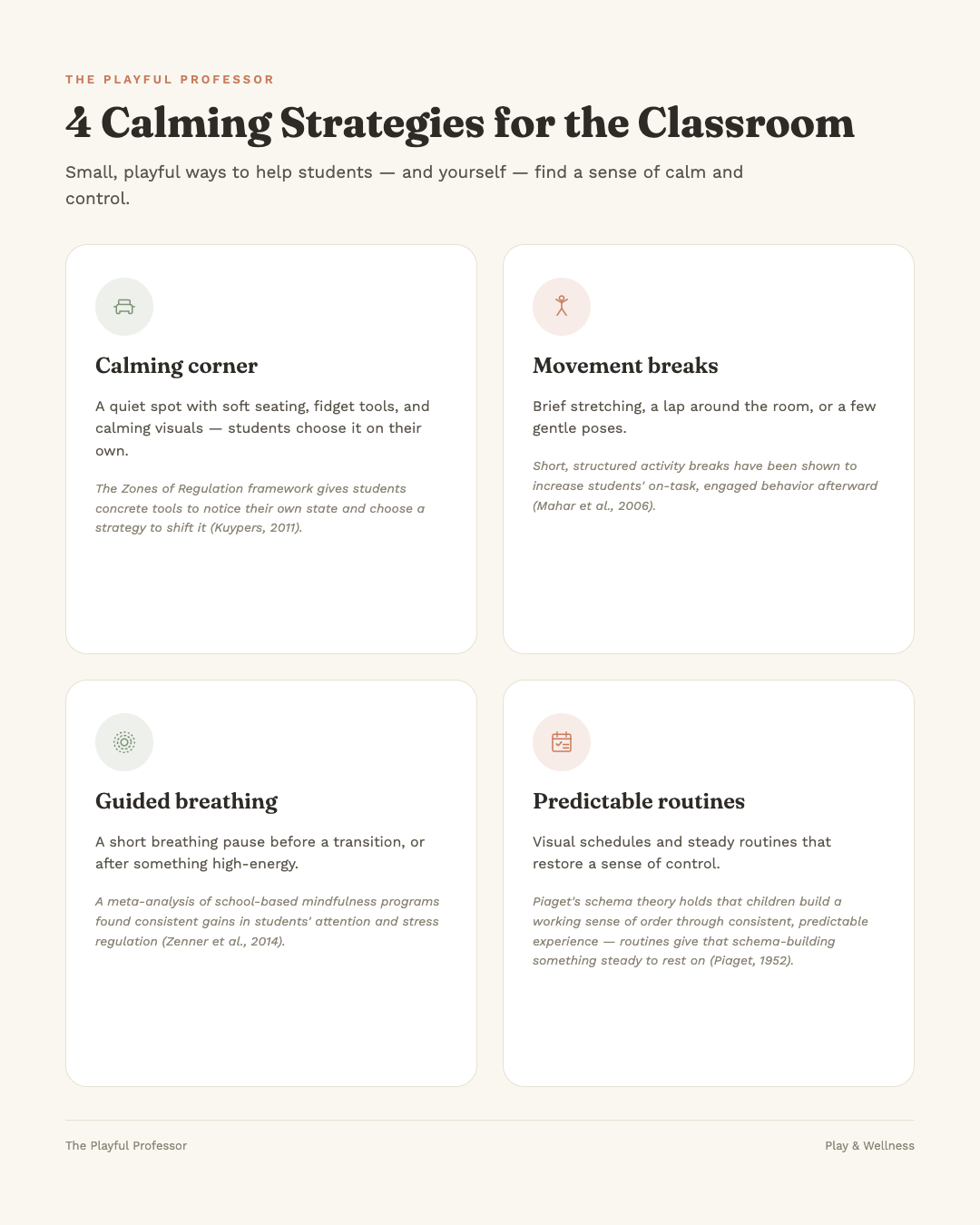
A calming corner with soft seating, fidget tools, and calming visuals students can choose on their own.
Brief movement breaks — stretching, a lap around the room, a few gentle poses.
Short guided breathing before a transition or after something high-energy.
Predictable routines and visual schedules that restore a sense of control.
The common thread across all of it is CHOICE. We invite students into these strategies; we don’t require them.
Actionable takeaways for the week ahead
Normalize the toolkit before the crisis. Introduce a calming corner or breathing routine when things are calm, so it reads as a normal option rather than a consequence.
Offer more than one entry point. Some of us regulate through movement, some through quiet, some through making something. Build a menu, not a mandate.
Model it ourselves. Let students — or colleagues, or our own kids — see us take a breath, stretch, or step outside for a minute.
Remember play isn’t frivolous here. For a dysregulated nervous system, playful, embodied experience isn’t a break from the healing. It may be part of the healing itself.
You see, play is not the opposite of hard things. Instead, it may be one of the more reliable ways back through them.
Sources
Brown, S. (2009). Play: How It Shapes the Brain, Opens the Imagination, and Invigorates the Soul. New York, NY: Avery.
Fricchione, G.L., Khalsa, G., & Benson, H. (2000). Functional brain mapping of the relaxation response and meditation. NeuroReport, 11(7), 1581–1585.
Kuypers, L. (2011). The zones of regulation: A curriculum designed to foster self-regulation and emotional control. Think Social Publishing.
Lazar, S. W., Bush, G., Gollub, R. L., Fricchione, G. L., Khalsa, G., & Benson, H. (2000). Functional brain mapping of the relaxation response and meditation. NeuroReport, 11(7), 1581–1585.
Mahar, M. T., Murphy, S. K., Rowe, D. A., Golden, J., Shields, A. T., & Raedeke, T. D. (2006). Effects of a classroom-based program on physical activity and on-task behavior. Medicine & Science in Sports & Exercise, 38(12), 2086–2094.
National Institute of Mental Health. (2022). Major depression. https://www.nimh.nih.gov/health/statistics/major-depression
Piaget, J. (1952). The origins of intelligence in children (M. Cook, Trans.). International Universities Press. https://doi.org/10.1037/11494-000
van der Kolk, B. (2014). The Body Keeps the Score: Brain, Mind, and Body in the Healing of Trauma. New York, NY: Viking. Lazar, S.W., Bush, G., Gollub, R.L., Zenner, C., Herrnleben-Kurz, S., & Walach, H. (2014). Mindfulness-based interventions in schools — A systematic review and meta-analysis. Frontiers in Psychology, 5, Article 603. https://doi.org/10.3389/fpsyg.2014.00603
As a play ambassador for the US Play Coalition, I’m passionate about sharing the power of play for wellness and overall happy lives. As you continue to seek answers to your own questions on play, you might be interested in the following articles:
The Power of Play: Five steps for unlocking creativity and joy in our everyday lives
How to find your dream job: The role of play personalities in fulfillment
Do you need additional support for incorporating play in your life?
Consider buying my books on Bookshop.org, Barnes & Noble, Target, or Amazon. I appreciate the love.
Get some play swag from my online store.