
You're More Creative Than You Think. (It Has Nothing to Do With Art.)
"I'm just not creative." I hear it from teachers in workshops, from parents at the bookshop, from colleagues across the table. Usually right after someone says, "I can't draw."
Here's the thing, y'all— creativity is not the degree to which you can create art. Too often, creativity gets relegated to artistic ability, and it's that misconception that scares people away from the idea entirely.
What creativity actually is
Dictionary.com defines creativity as "the ability to transcend traditional ideas, rules, patterns, relationships, or the like, and to create meaningful new ideas, forms, methods, interpretations, etc." Notice what's missing? Art. Not one mention.
We tend to give artists credit for being the sole owners of creativity, because they take a blank canvas, a lump of clay, or a tune only heard in their heads and turn it into something no one has seen before.
That is creative.
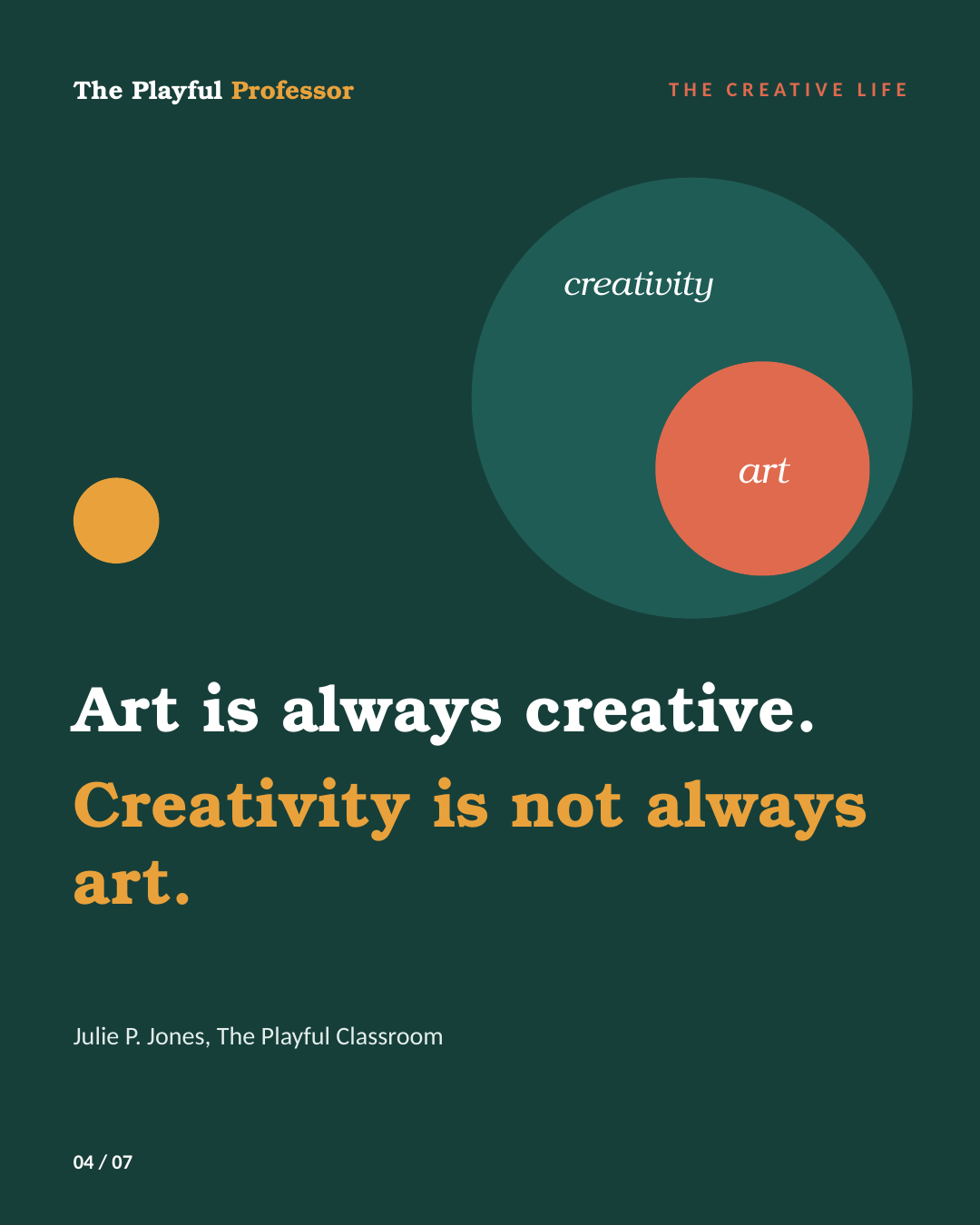
But think of it like this: a square is always a rectangle, but a rectangle isn't always a square. Art is always creative. Creativity is not always art.
Creativity is looking at a ruler and finding ten purposes for it besides measuring and drawing straight lines. It's packing a suitcase in a way no one else thought of. It's seeing a crack in the concrete floor of the coffee shop and imagining a river that runs through a tiny, unseen village of creatures no one has discovered yet.
The secret: fresh eyes
There's no magic pill.
No rules like "don't wear white shoes after Labor Day."
Creativity is simply taking something we encounter every day (a person, a situation, an idea) and looking at it with fresh eyes. Taking something ordinary and making it new. Making it playful.
When my girls were young enough to need me to drive them to school, we would take a 20-minute drive through the country past fields of cows. One morning I missed the cows entirely, because on the other side of the road was a horse. The blackest, most beautiful creature, with a white spot right where his forehead would be. So naturally, we named him Moon. Then, Dr. Moon. By the end of the drive, Dr. Moon had a whole backstory: the other horses had been rude to him, and he needed some new horse friends. Bless him.
It didn't cost anything. It wasn't complicated. It was an ordinary morning drive, seen with fresh eyes.
Lin-Manuel Miranda had that same kind of moment on a beach vacation. He picked up Ron Chernow's 2004 biography of Alexander Hamilton, a man he knew mostly as the guy on the $10 bill who died in a duel, and thought, That's a hip-hop story. Thousands of people had read that same book.
The difference was how he looked at it.
Don't think outside the box.
Destroy it.
We're always being told to think outside the box. In The Playful Classroom, I suggest destroying the box completely. The idea comes from Antoinette Portis's picture book Not a Box, in which a bunny insists the cardboard box is a rocket ship, a mountain, a whole world waiting to be discovered. The point isn't simply to change our thinking. It's to change the way we think about thinking.
Try this
The Alternative Uses challenge (Christensen, 2015). Grab an everyday object: a ruler, a paper clip, a spoon. Play one song and while you listen, list every use you can think of besides the obvious one. Then play a second song and keep going. The first list is usually practical (a doorstop, a conductor's baton, a sword). The second list is where the box falls apart: a bridge for ants escaping a flood, a tiny wooden leg for a miniature pirate. More time, space, and opportunity make the ideas better.
In the classroom: swap one routine for a fresh-eyes version. Instead of flashcards, write or sing a song with the facts. Instead of the practice sheet on setting, build the setting with LEGOs and act out the plot.
Beyond the classroom: pick one ordinary moment this week (the commute, the dishes, the waiting room) and give something in it a name and a backstory. See what happens.
Creativity isn't a talent some people got and the rest of us missed.
It's a way of seeing.
And we can all practice looking.
Sources
Chernow, R. (2004). Alexander Hamilton. Penguin Press.
Christensen, T. (2015). The creativity challenge: Design, experiment, test, innovate, build, create, inspire, and unleash your genius. Adams Media.
Dictionary.com. (n.d.). Creativity. In Dictionary.com.
Gibbs (2017). Interview with Lin-Manuel Miranda. [Link](https://www.cnbc.com/make-it/2017/12/28/hamilton-creator-lin-manuel-miranda-on-the-making-of-the-musical.html)
Jones, J. P., & Dearybury, J. (2020). The playful classroom. Wiley Jossey-Bass.
Portis, A. (2006). Not a box. HarperCollins.
