Your Best Ideas Aren’t Happening at Your Desk. Here’s Why.
You know the moment. You’re in the shower, folding laundry, or driving a route you’ve driven a hundred times — and the answer to a problem you’d given up on for the day just… arrives. Not because you worked harder for it. Because you stopped trying.
The network that only shows up when we stop trying
When we check out mentally — daydream, doodle, stare out a window — our resting brain switches to what neuroscientists call the default mode network, or DMN (Pang, 2016). People with a more active, well-developed DMN tend to show stronger reading comprehension, better memory, higher measures of intelligence and attention, and greater empathy (Pang, 2016).
Read more on the DMN in this special issue from Science Direct.
Play doesn’t just relax us. It makes us better problem-solvers.
Multiple studies link play directly to divergent thinking — the ability to generate many possible solutions instead of hunting for the one “correct” answer (Pepler & Ross, 1981; Wyver & Spence, 1999). Play also builds imagination, and imagination is a prerequisite for empathy (DeBenedet, 2018; Frank, 1978).
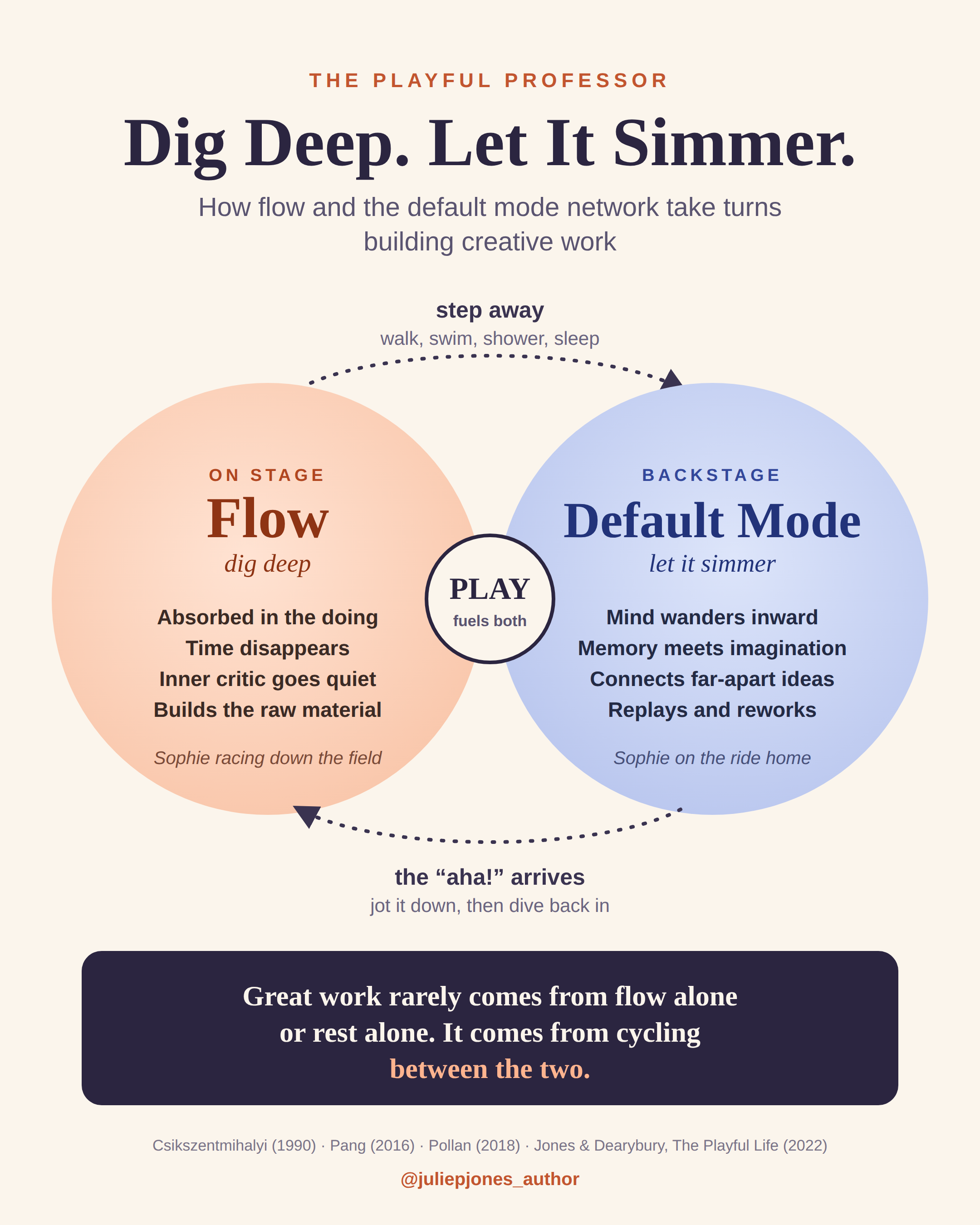
Flow and daydreaming aren’t opposites — they’re a cycle
Creative breakthroughs tend to come from two different mental states working in tandem: flow, when we’re so absorbed in a task that time disappears, and the DMN, when we’ve stepped back and our brain quietly keeps working. As author and product designer Tanner Christensen put it, “Play removes limits that otherwise constrain us to what we currently know to be possible” (Christensen, 2015).
What this means for Monday morning
Stop treating silence as wasted time.
Let transitions breathe.
Give divergent-thinking tasks room to be genuinely open.
Model your own wandering.
The best ideas in our classrooms — ours and our students’ — are often waiting on the other side of a little unstructured play.
Sources
Christensen, T. (2015). The creativity challenge: Design, experiment, test, innovate, build, create, inspire, and unleash your genius. Avon, MA: Adams Media.
DeBenedet, A. T. (2018). Playful intelligence: The power of living lightly in a serious world. Solana Beach, CA: Santa Monica Press LLC.
Pang, A. (2016). Rest: Why you get more done when you work less. New York, NY: Basic Books.
Frank, S. J. (1978). Just imagine how I feel: How to improve empathy through training in imagination. In J. Singer & K. Pope (Eds.), The power of human imagination: New methods in psychotherapy. New York: Springer.
Pepler, D.J., & Ross, H.S. (1981). The effects of play on convergent and divergent problem solving. Child Development, 52(4), 1202–1210.
Wyver, S.R., & Spence, S.H. (1999). Play and divergent problem solving: Evidence supporting a reciprocal relationship. Early Education and Development, 10(4), 419–444.
Do you need additional support for incorporating play in your life?
Follow my quest for the playful life: Instagram, Facebook, LinkedIn
Consider buying my books on Bookshop.org, Barnes & Noble, Target, or Amazon. I appreciate the love.
Read the free content on my website.
Buy some PLAY-swag.