
Where Good Ideas Come From (and What to Do When One Shows Up)
Think about the last time an idea grabbed you. A trip you wanted to plan, a lesson you wanted to try, a business, a garden bed, a YouTube channel. Where were you? Were you reading? Writing? Doodling? Chatting with a friend? Playing?
Ideas rarely arrive at a desk on command. And once they arrive, most of us aren’t sure what to do with them. So here’s the process I use. It looks like a tidy four-step list. In real life, y’all, it’s more like a game of Frogger: up, down, left, right, back, forward, and repeat.
Receive
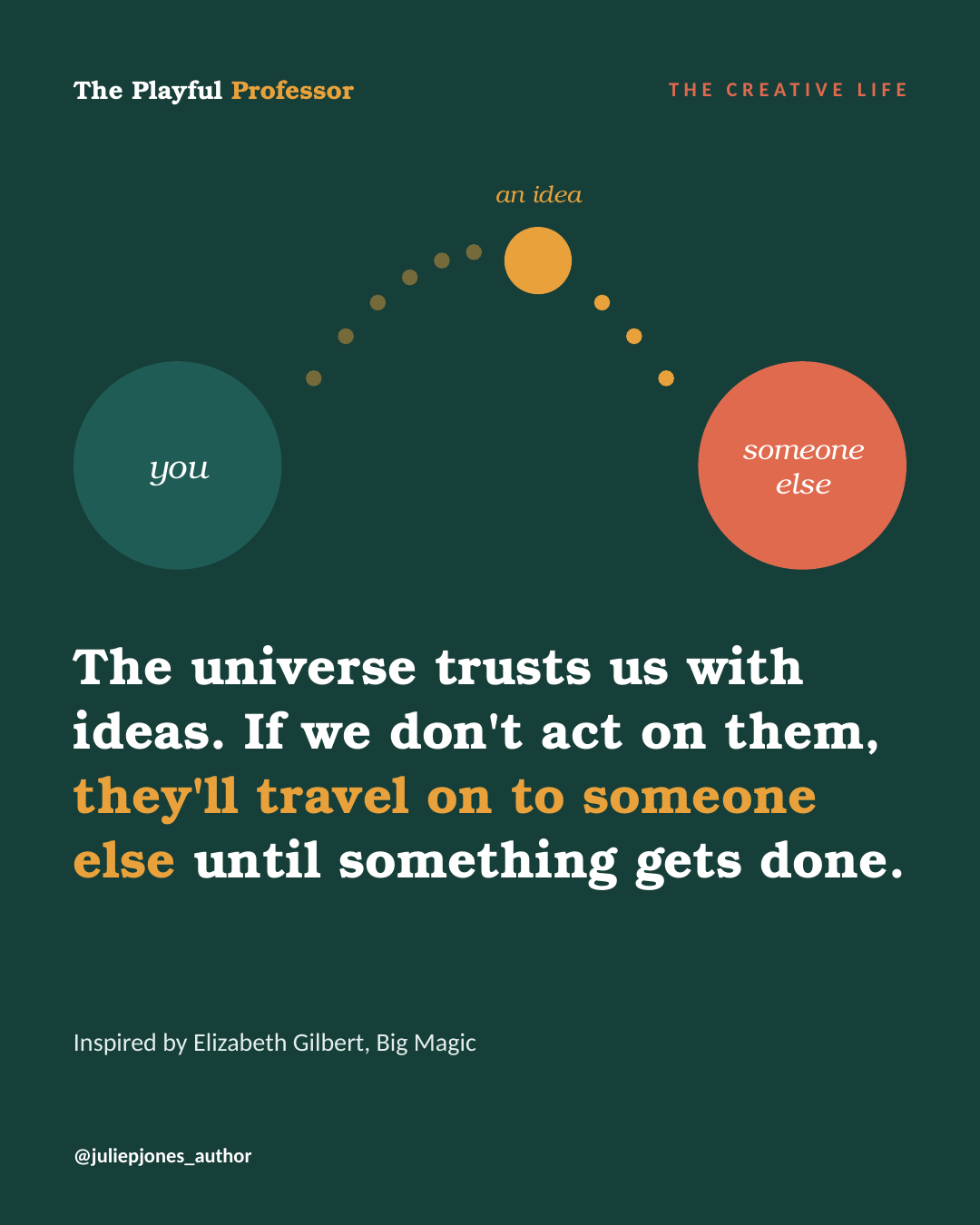
Elizabeth Gilbert calls ideation Big Magic. In her telling, the universe trusts us with ideas, and if we don’t act on them, they’ll travel on to someone else until something gets done. There may be millions of videos online, but the world still needs yours, because that particular idea dropped into your mind.
Receiving is about noticing. Capture the idea when it comes: a notebook, a voice memo, the back of a receipt. You can’t shape what you didn’t catch.
Simmer
Meryl Streep’s advice (at least according to the little box of quotes I picked up at Target) is “Start by starting.” And sometimes that’s right. But often, allowing ourselves the time and freedom to make an idea our own leads to an idea on top of an idea.
Think of a pot on the stove. It’s on. It’s warm. It isn’t boiling yet, but everything in it is blending. When we let an idea simmer, our default mode network (the part of the brain that keeps working when we step away) quietly connects it to everything else we know. Creativity is an idea in motion. An idea leads to an idea, which leads to another idea, and then a whole new idea.
Author Amor Towles works this way. He carries notebooks everywhere and jots down ideas as they come. A story might percolate for years before he writes the novel straight through, and he only does that once he knows the magic is ready. Howard Gardner of Harvard calls people who work like this synthesizing minds: they gather, connect, and combine.
Simmering isn’t stalling. It’s cooking.
Shape
You’ve mulled it over. Now, like a lump of clay, you start pushing and pulling. You knead the concept. You show it to your inner circle and ask for feedback. Somewhere in the shaping, the magic happens: the work becomes singular. You have something unlike anyone else’s something. That’s what innovation feels like from the inside.
Kinesthetize
Yes, I made this word up. Play researcher Stuart Brown once invented a word to capture his thinking, so I’m following his lead. It means getting your idea moving and revealing it to the world.
Srinivas Rao writes about creating for an audience of one: making work that pleases yourself first, which can increase your productivity and happiness and, paradoxically, eventually grow your audience. That’s lovely. But greatness is often meant to be shared. Without an audience, we have no feedback, and without feedback, how do we move forward? Is this the last step? No. It could be the first. It can be threaded through the whole thing.
The honest part
This looks linear. It is not. Sometimes it’s a muddy mess, and we have to be brave enough to get dirty with it. We can’t have an idea unless we honor the need for time, space, and opportunity to play with concepts. And the whole process involves risk: risk of failure, of judgment, of exposure, even of success. (More on that in the next post.)
Try this
Start an idea catcher. One notebook, one notes app, one place. Every idea goes in, no matter how half-baked.
Give one idea a simmer week. Pick an idea from the catcher and revisit it once a day for a week. Add one sentence each time. Watch it grow.
Teachers: build simmer time into projects. Before students build, let them sketch, talk, and walk away for a day. Their second ideas are almost always better than their first.
Kinesthetize something small. Share one shaped idea with one trusted person this week.
Sources
Brown, S., & Vaughan, C. (2009). Play: How it shapes the brain, opens the imagination, and invigorates the soul. Avery.
Gardner, H. (2020). A synthesizing mind: A memoir from the creator of multiple intelligences theory. MIT Press.
Gilbert, E. (2015). Big magic: Creative living beyond fear. Riverhead Books.
Jones, J. P., & Dearybury, J. (2022). The playful life. Wiley Jossey Bass.
Rao, S. (2018). An audience of one: Reclaiming creativity for its own sake. Portfolio.
