
Confession: when I'm stuck in traffic, I talk to it. In my own (my friend Darryl would say awful) British accent. "Oh, brilliant. Another jam. Lovely." I promise it doesn't feel nearly as bad that way.
That's not just me being silly (okay, it's a little bit me being silly). It's imagination doing one of its most important jobs.
What researchers found when they studied playful adults
Dr. Anthony DeBenedet analyzed hundreds of interviews for his book Playful Intelligence and identified five qualities of playful adults:
sociability,
wonder,
Imagination,
spontaneity, and
humor.
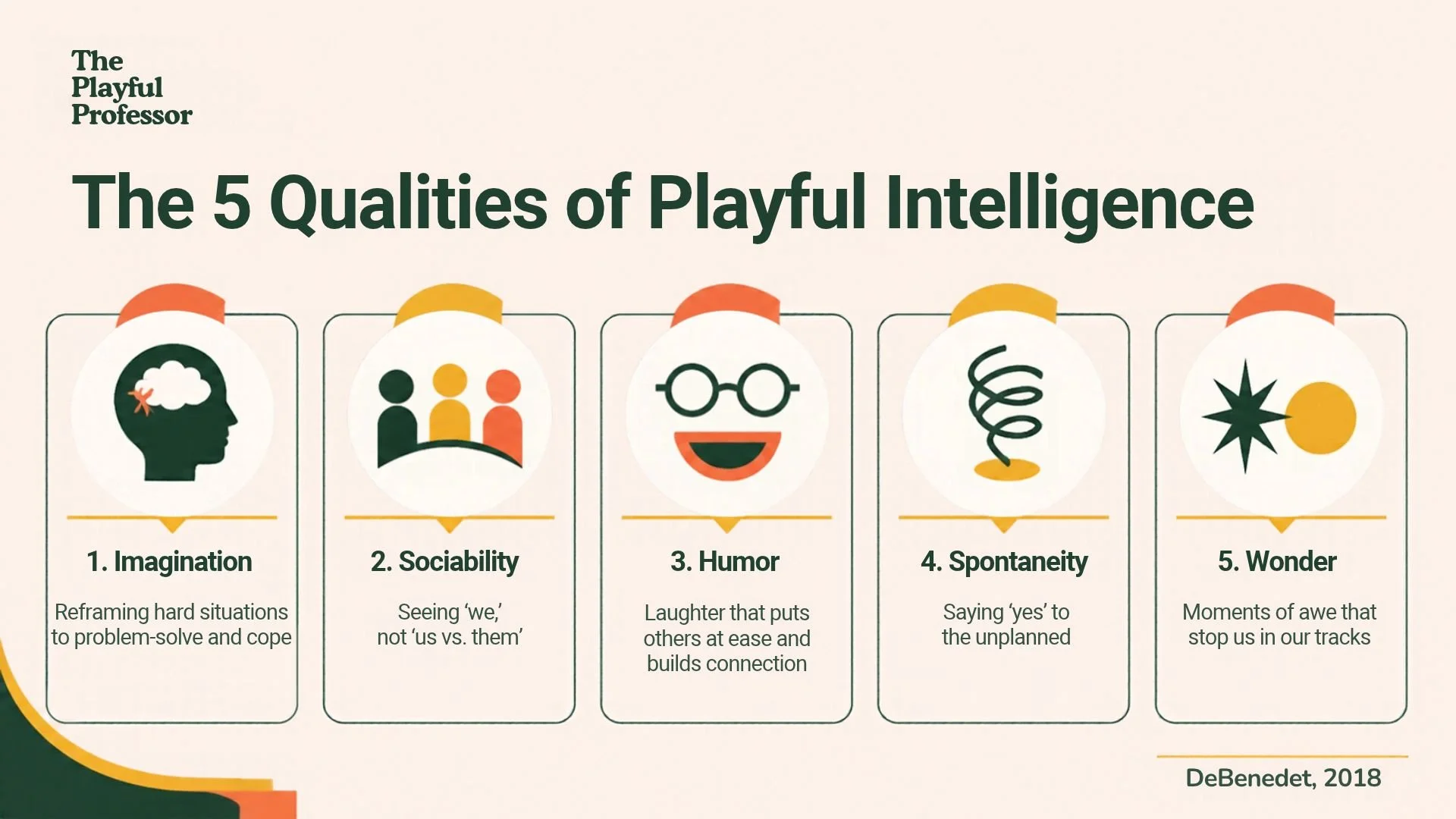
You might expect imagination to show up as artistic or musical talent. DeBenedet did too. But that's not where he found it. In healthy adults, imagination showed up as the ability to psychologically reframe difficult situations. Not escaping our struggles, but seeing them differently, and using that new view to problem-solve and cope.
Traffic jam ahead? Fun detour to somewhere new, or extra time for a car dance party. Caught in the rain? Jump in the puddles and pretend you're Gene Kelly. None of it makes the hard thing disappear. It simply changes how we move through it.
Imagination is hope with a plan
I take piano lessons weekly at Converse. My teacher, Erica, often kindly rolls her eyes when I go rogue, and she tells me, “Hope is not a plan, Julie.” I grin. She says this in love.
While the saying doesn’t apply to piano in my case, it does apply to imagination. Here's how I think about it: imagination is the ability to take whatever situation we have, reimagine it as what we hope it could be, and take the steps to move forward. The key is the hope.
In Matt de la Peña's picture book Milo Imagines the World, Milo is stuck on a long subway ride with his older sister. Instead of being bored, he studies the faces around him and draws pictures of their lives: the whiskered man with the crossword playing solitaire in an apartment full of pets, the boy in the suit arriving home to a castle with a drawbridge. Milo took a lemon of a situation (waiting) and made it something else.
I've always wanted a room filled with books. When we moved during the 2020 pandemic, I made one. Now I sit in here with my feet up, breathing in the paper. And lately I've been eyeing my bedside table. I don't need a table there. I need low, matching bookshelves on each side, because I read in bed All. The. Time. Add my love of thrifting and repurposing, and I'm on a mission.
It's a small thing. But, that’s the point. Imagination doesn't have to be elaborate. It's seeing a space and imagining what it could be.
It builds empathy, too
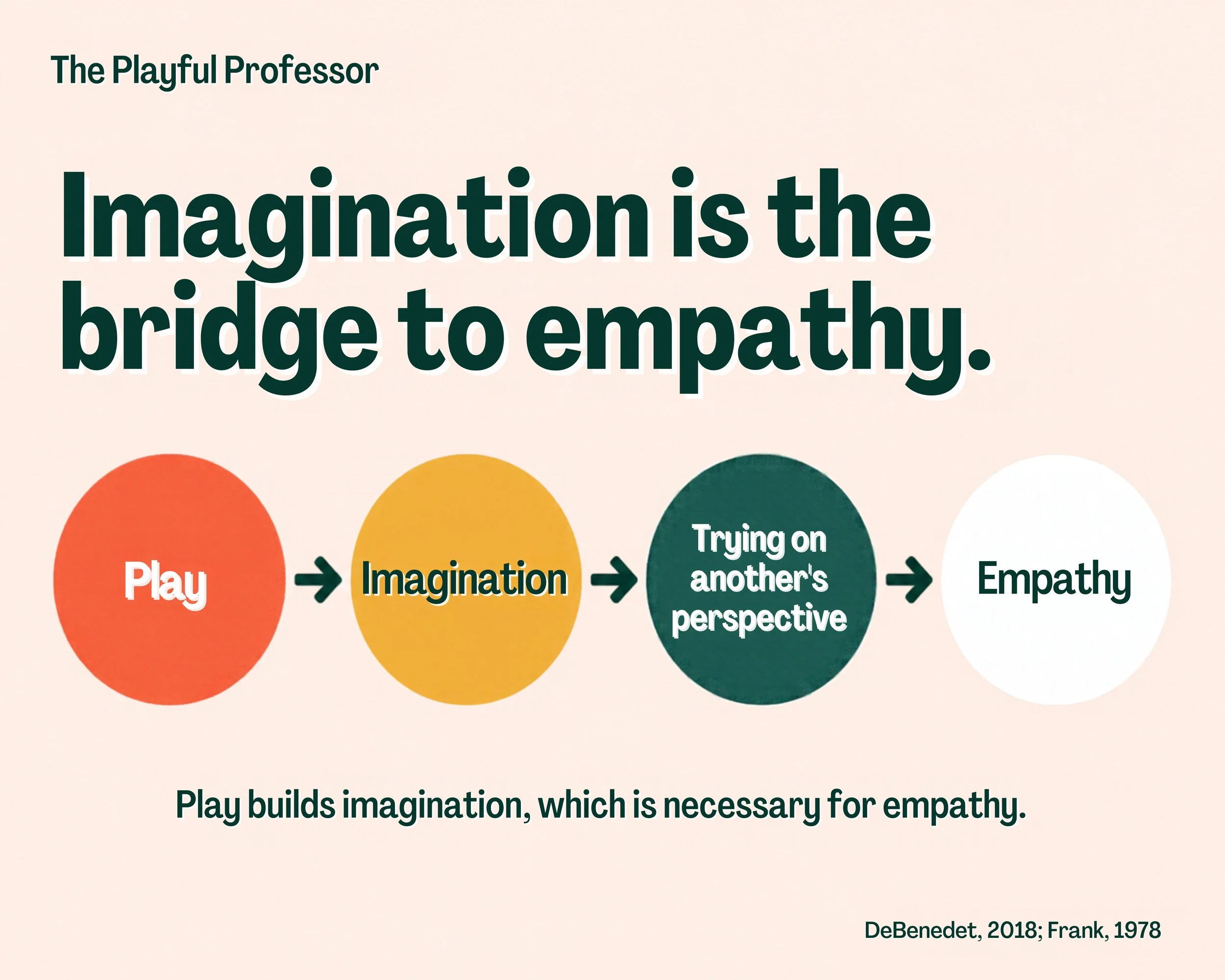
When we daydream and pretend, we're practicing imagining what someone else is experiencing. Exercising imagination increases our capacity for empathy (DeBenedet, 2018; Frank, 1978). That's what Milo was doing on the subway. And it's what our students are doing when they role-play, write stories, or ask, "What would it be like to be them?"
Try this
Reframe one annoyance this week. On hold with customer service? Have a private freeze dance opportunity: freeze every time the recorded voice thanks you for holding, unfreeze when the music comes back.
Play Milo in the waiting room. Imagine the backstory of the people around you. What do they drive? What's their papa’s name? What are they having for dinner? (Just don't stare too hard.)
Re-imagine one space. A corner, a shelf, a desk. What could it be instead?
Teachers: read Milo Imagines the World, then have students draw an imagined life for a character, a historical figure, or a classmate's favorite object. Ask: "How did imagining help you understand them?"
Imagination isn't a way out of hard days. It's a way through them.
Sources
DeBenedet, A. T. (2018). Playful intelligence: The power of living lightly in a serious world. Santa Monica Press.
de la Peña, M. (2021). Milo imagines the world (C. Robinson, Illus.). G. P. Putnam's Sons.
Frank, S. J. (1978). Just imagine how I feel: How to improve empathy through training in imagination. In J. Singer & K. Pope (Eds.), The power of human imagination: New methods in psychotherapy. Springer.
Jones, J. P., & Dearybury, J. (2022). The playful life.
Do you need additional support for incorporating play in your life?
1. Follow my quest for the playful life: Instagram, Facebook, LinkedIn
2. Consider buying my books on Bookshop.org, Barnes & Noble, Target, or Amazon. I appreciate the love.
3. Read the free content on my website.
4. Buy some PLAY-swag.
