
I have a friend with no social skills and a PhD in the history of palindromes.
I call him Dr. Awkward.
(I'll wait.)
Whether that made you laugh or groan, something just happened in your brain. And it's doing more for you than you might think.
What laughter does in the brain
When we laugh, when we experience joy, and the brain releases dopamine, the pleasure chemical. At the same time that neurons are firing these thoughts in the front of the brain, these happy chemicals are pushing up from the back. I picture it like Mickey conducting in Fantasia: colors blasting, instruments playing, everything poppin' to the beat. When our brains make these connections, we build resiliency, one of the main benefits of humor. How? Humor helps shift our cognitive perspective, changing the body's stress response, and strengthening social bonds during difficult times.
The U.S. Department of Veterans Affairs lists some of laughter's benefits for the body:
It lowers levels of cortisol, the stress hormone.
It activates the brain's reward system.
It raises beta-endorphins, the body's feel-good chemicals.
It briefly increases heart rate and oxygen intake, and then moves us into a state of relaxation.
Humor and creativity are cousins
We laugh, generally, because what we see or hear goes against what we expected. Humor comes from surprise. And surprise is exactly what creativity runs on: seeing something in a way nobody saw coming. As writer Tracy Brower put it, the distance from "ha ha" to "aha" is short.
Knock knock.
Who's there?
Yoda lady.
Yoda lady who?
I didn't know you could yodel.
That joke works because of an unexpected connection. So do a lot of great ideas. Some of history's most serious thinkers were famously playful. Alexander Fleming, who discovered penicillin, described his work as "playing with microbes." Mozart was notorious for pranks and jokes, and you can hear them in his music. James Watson and Francis Crick worked out the structure of DNA by building models with colored balls, much like you'd find in a kindergarten classroom.
And it's how we connect
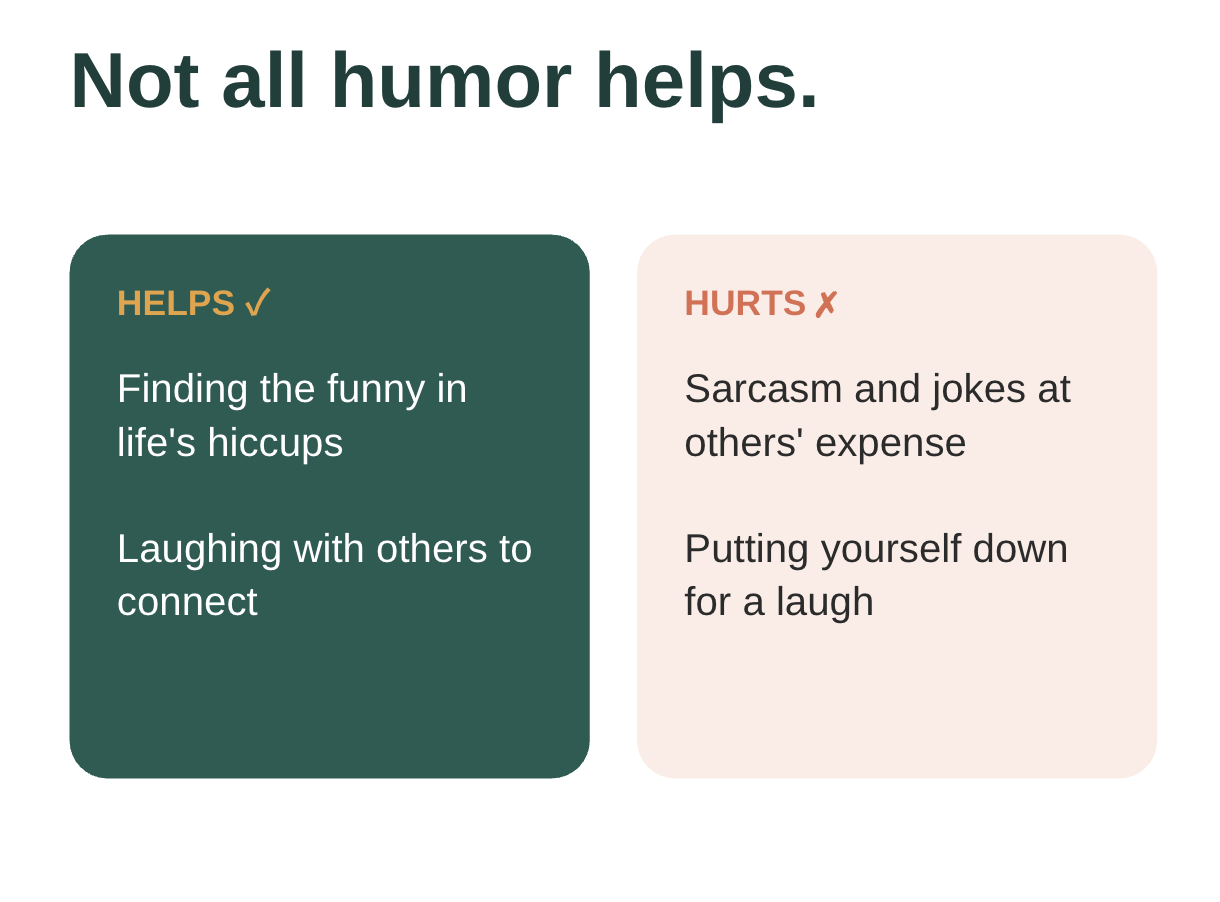
That's what happens in the brain. But there's also the part we feel in our hearts: human connection. When humor is used to put others at ease and to strengthen relationships (not to put anyone down), we open up and engage honestly with each other. Humor relieves tension, reassures people, and draws them together.
Try this
Swap one commute podcast. The news can be heavy. Trade one drive for something that makes you laugh out loud.
Start a meeting with a laugh. A pun, a funny photo, a "would you rather." It lowers the stakes so people share ideas more freely.
Teachers: try a joke of the day, written by students. Ask them to explain why it's funny. They'll be practicing the unexpected connections that drive both humor and creative thinking.
Text a friend something silly today. Laughter is contagious, and that's the point.
How often do we invite laughter in to build community and grow the bonds of friendship? Maybe we can practice a little more often than we do now.
Sources
Bateson, P., & Martin, P. (2013). Play, playfulness, creativity and innovation. Cambridge University Press.
Brower, T. (2019, March 3). Boost productivity 20%: The surprising power of play. Forbes.
Jones, J. P., & Dearybury, J. (2022). The playful life. Wiley-Jossey Bass.
McGraw-Hill. (2025). Laugh First, Worry Later: How Humor Builds Resilience and Leadership. Link
U.S. Department of Veterans Affairs. (2020). The healing benefits of humor and laughter. va.gov
Do you need additional support for incorporating play in your life?
1. Follow my quest for the playful life: Instagram, Facebook, LinkedIn
2. Consider buying my books on Bookshop.org, Barnes & Noble, Target, or Amazon. I appreciate the love.
3. Read the free content on my website.
4. Buy some PLAY-swag.
