
Fail Better: What Disneyland’s Disastrous First Day Teaches Us About Creating Anything
July 17, 1955.
Disneyland opens its gates. They’re expecting about 15,000 invited guests. Thanks to counterfeit tickets, nearly double that shows up.
The lines are miserable. The park runs out of food. Rides break down or aren’t ready to open at all. The temperature climbs past 100 degrees, a plumbers’ strike means many of the water fountains don’t work, and the asphalt on Main Street, USA is so freshly poured that women’s heels sink right into it. Employees later nicknamed the day “Black Sunday.”
Walt Disney’s response, when he learned what had happened? “If you do big things, you make big mistakes.”
Imagine if he had thrown in the towel right then. I’m so thankful he didn’t, because I have so many memories at Walt Disney World, which opened sixteen years later.
Failure is part of every play experience.
Someone’s block tower will fall.
Someone will lose the game.
Someone will spill the paint and ruin the picture.
And in those moments, we learn to play better, stronger, and wiser the next time.
Creating anything works the same way.
Thomas Edison made thousands of unsuccessful attempts at the light bulb.
The Wright brothers spent years crashing before they got anywhere close to powered flight.
Michael Jordan was cut from his high school varsity team.
Stephen King’s Carrie? 30 rejections
Robert Pirsig’s Zen and the Art of Motorcycle Maintenance? 121 rejections
Jay-Z was turned down by record labels, so he started his own.
Oprah was fired from her first anchor job for getting too emotionally attached to her stories, the very quality that later made her who she is.
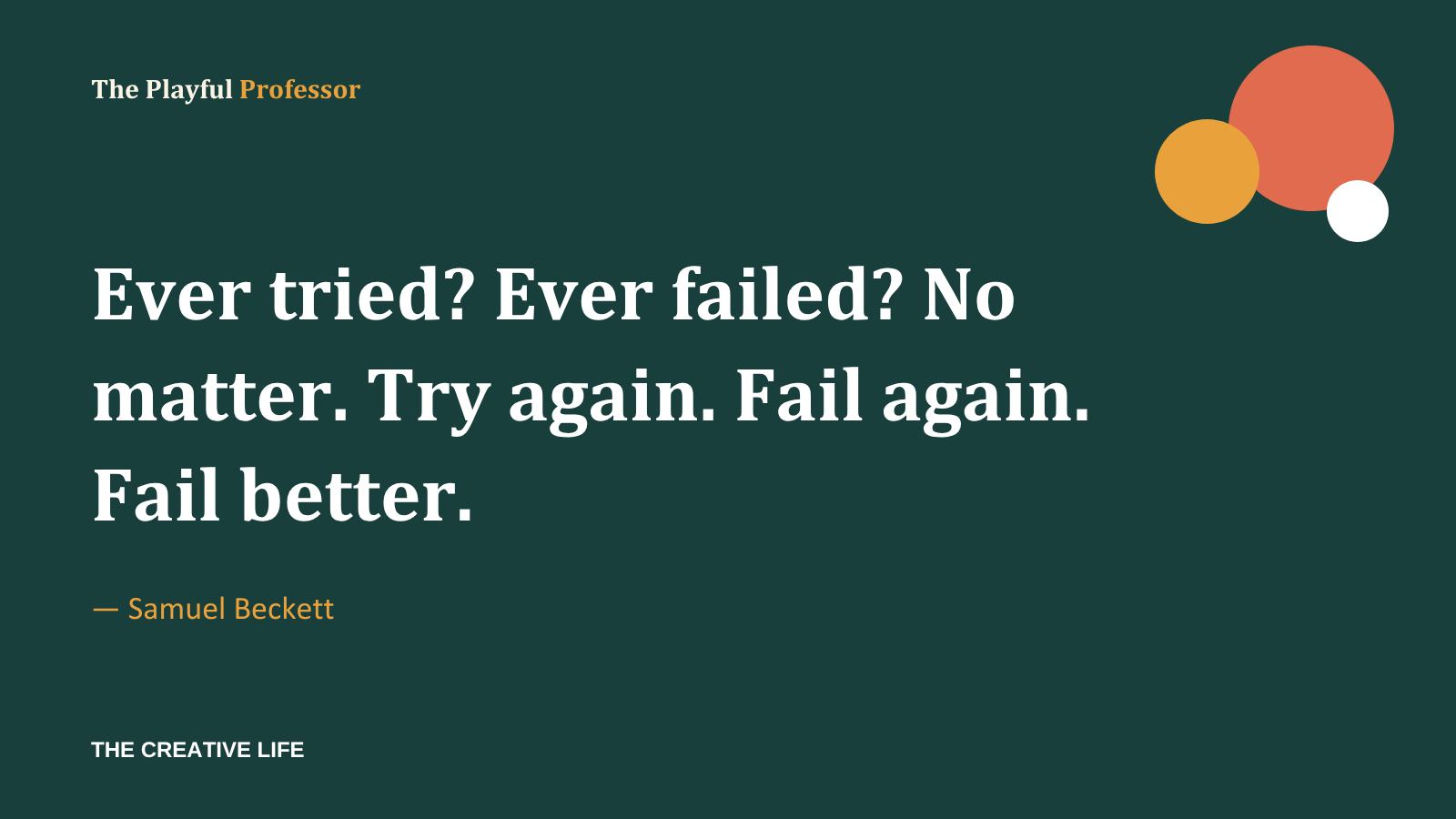
Samuel Beckett said it best: “Ever tried? Ever failed? No matter. Try again. Fail again. Fail better.”
The problem with the F
Sadly, in our education world, the most common use of the word fail is the F on a report card. And that letter carries a lot of baggage. In one workshop, a room full of teachers was shown a student’s work with an F at the top and asked to describe the student based only on that page. Almost every response was negative.
Robert and Michele Root-Bernstein, in Sparks of Genius, point out a common thread among many of the world’s most creative thinkers: school often held them back, because they were the “failures.” Yet trying and failing is how we learn best. If there is any place where failure should be inspected, expected, and respected, it’s in schools.
I’ll go first
When my first book launched, I was terrified. It felt like standing on Main Street, USA, stuck in that fresh asphalt, singing in front of thousands of people with no pants on. Having your thoughts in print, readily available for anyone to read, dissect, critique, and review online? And here I am, doing it again. Every blog post I write carries a little bit of that same feeling.
Fear is real, y’all. But mistakes aren’t evidence that we can’t. They’re evidence that we tried.
Try this
Pick something you’ve never done and are pretty sure you’ll be bad at: a pottery class, a pickup game, a song at open mic night, a dinner made without a recipe. Do it somewhere at least one other person can see. When it goes sideways, and it will, notice what you learned instead of how it looked. Then go back a second time. The point isn’t to get good. It’s to remind ourselves that falling short is survivable, and usually more interesting than we feared.
Teachers: Before you explain a new concept, hand students a challenging problem they don’t yet have the tools to solve. In history, that might be “Why did this treaty fall apart?” before any lecture. In biology, it could be “Design an experiment to test this,” and in English, “Write the opening line of this story three different ways.”
Give them time in small groups to wrestle with it. Most groups won’t get it right, and that’s the plan. Then teach the concept, and let them compare their attempts to it. The struggle primes students to understand why the real answer works.
Learning scientist Manu Kapur calls this productive failure. An article he also published in 2021 with Tanmay Sinha analyzed 53 studies of STEM students worldwide. The finding — carefully designed problem-solving before instruction had nearly twice the effect when compared to a year of instruction from a good teacher**.
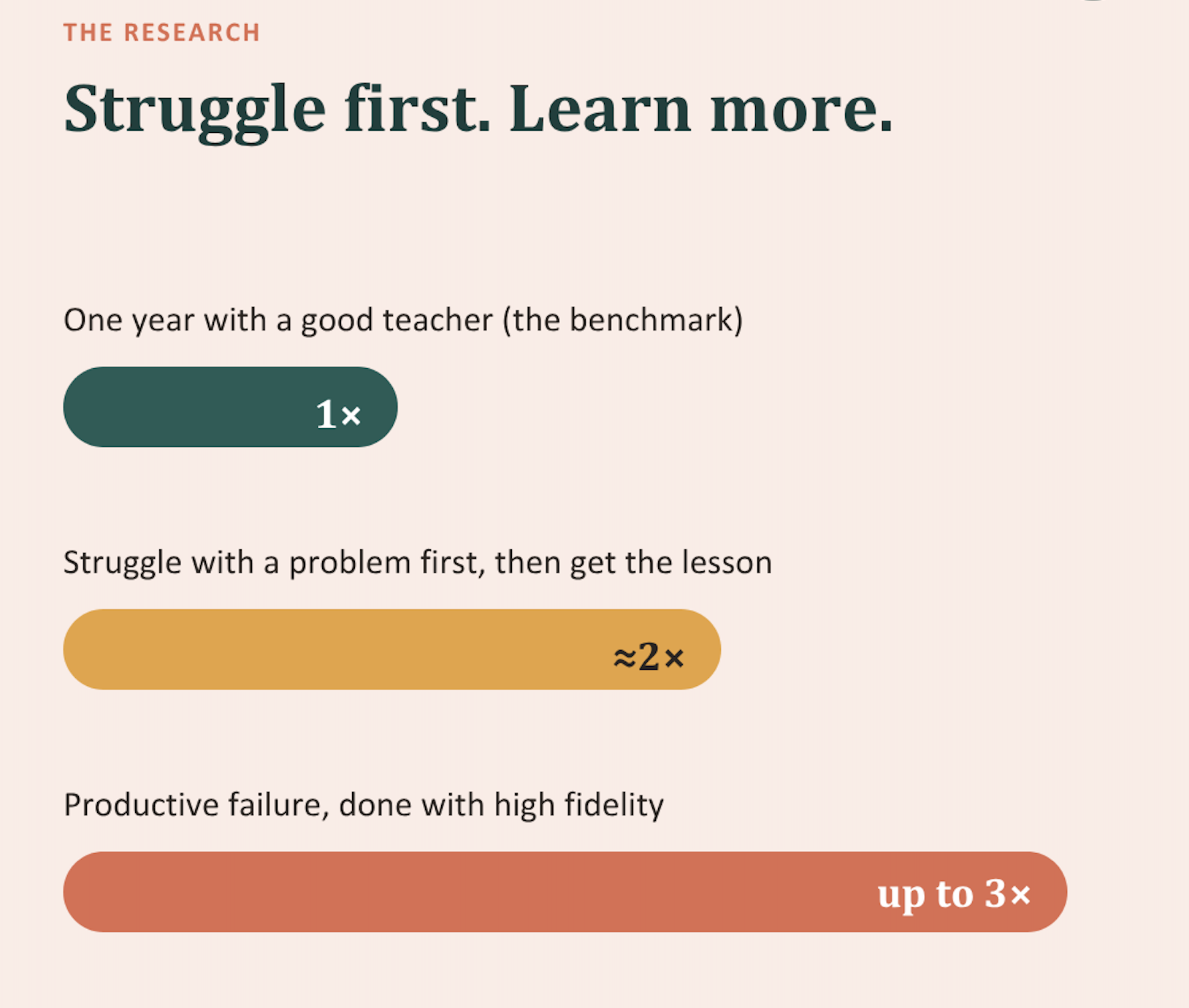
**Note on research finding: Problem-solving proceeding direct instruction did not hold the same advantage for second and fifth graders as it did for older students, and a direct instruction-first approach was equally as effective for teaching procedural skills.
This research shows that we struggle first, we often understand concepts more deeply than when we are taught the method up front. And isn’t that the point?
If we do big things, we make big mistakes.
So let’s go make some.
Sources
Beckett, S. (1983). Worstward ho. John Calder.
France, V. A. (1991). Window on Main Street: 35 years of creating happiness at Disneyland Park. Stabur Press.
Jones, J. P., & Dearybury, J. (2020). The playful classroom. Jossey-Bass.
Jones, J. P., & Dearybury, J. (2022). The playful life. Jossey-Bass
Root-Bernstein, R., & Root-Bernstein, M. (1999). Sparks of genius: The thirteen thinking tools of the world’s most creative people. Houghton Mifflin.
Do you need additional support for incorporating play in your life?
Follow my quest for the playful life: Instagram, Facebook, LinkedIn
Consider buying my books on Bookshop.org, Barnes & Noble, Target, or Amazon. I appreciate the love.
Read the free content on my website.
Buy some PLAY-swag.
